The speech ‘Living in Paradise: evolution, ecology and conservation of Seychelles caecilian amphibians’ was given by Dr Simon Maddock from University of Wolverhampton, who is a reptile and amphibian ecologist, evolutionary biologist and conservationist.
General introduction of Caecilians
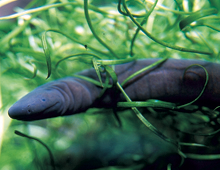
Typhlonectes natans
Caecilians are group of limbless, serpentine amphibians that usually live in tropical habitats, and all modern caecilians and their closest relatives are grouped as order Apoda in the clade Gymnophiona.
They usually have brown or dull coloured skins with spots or stripes down the length and only a few caecilian species have bright, colourful skins.
The word caecilian in New Latin means ‘blind ones’, because their eyes are not fully functional and usually covered by bones. This is mainly due to their underground habitat.
For adapting the underground environment, caecilians also developed ossified skulls, long linear body with strong muscles and backbones for digging and borrowing in the soil, and chemo-sensitive tentacles for detecting prey in dark environment.
Caecilians are normally carnivorous and have large teeth and shark-like powerful jaws that consists of crisscross muscle mechanism for tearing meats from the prey.
However, because of caecilians’ special underground living habits, the knowledge on caecilians are limited. For better understanding and protecting of caecilian species, Dr Simon Maddock carried out his research work in Seychelles.
Seychelles
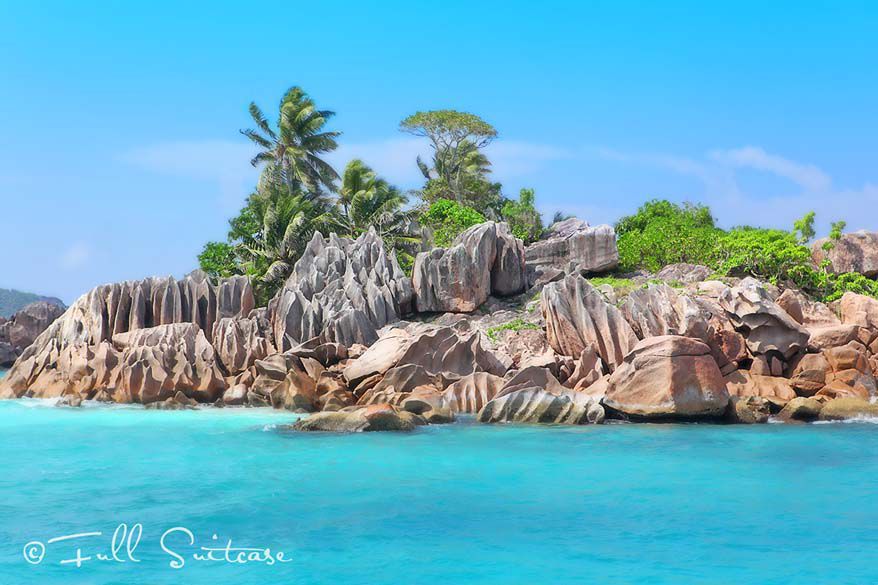
From
https://fullsuitcase.com/island-hopping-seychelles/
Seychelles located in the Indian Ocean off East Africa, it constitutes of 115 islands and the special geological location made it a biodiversity hotspot.
Caecilians are very common in Seychelles and there are around seventy caecilian species being found in Seychelles (with lots of rare kinds). E.g. the smallest caecilian species named Petite Praslin.
The evolution and ecology study and conservation work in Seychelles
For studying the evolution history and doing the conservation work for caecilians in Seychelles. Dr Simon Maddock and his team successfully recorded around 700 individuals and carried out the climate and long-term monitoring for over 300 samples.
Luckily, during the field work, two new species of caecilians were identified, which are Hypogeophis pti (The world newest and possibly the smallest caecilian) and Hypogeophis montanus.
Also, Dr Simon Maddock suggested several main threats to caecilians:
• Diseases
• Habitat loss
• Climate change
• Pollution
• Invasive species
• Lack of knowledge for caecilians protection
Personal thoughts
The studying of caecilian species seems to be an interesting topic, the mystery about caecilian species’ evolutionary history attracts me a lot. More importantly, with the fast advance of genomic and sequencing technologies. There might be several recent or upcoming researches on caecilian species with the help of new molecular ecology and evolution approaches.
Therefore, this could be a potential career path for me, and I could try to start to find the related job or research positions.
Short introduction of Caecilians
 Yicheng Jin's Blog